How Moving Averages Can Help You Time The Market - Without Trying To Predict It

Image Details: Stock Image of the DJI Index, from Squarespace
* NOTE: none of the info in this article or ANY article of MacroBytes is investment advice or political opinion, it is solely informational for editorial purposes. All market research in this article is sourced, and the purpose of these articles is solely to synthesize topics out of curiosity while sourcing all relevant sources. Summaries are created via a combination of market research, individual opinion, and AI-Workflows. Numerous aspects of the article are also independent ideas and opinions that I have framed from the research conducted.
Introduction
Over the past year, I’ve had the opportunity as part of the University of Illinois Urbana-Champaign’s Derivatives & Trading Academy (more info) to learn about numerous fundamental and technical indicators that have been the cornerstone of institutional investing and quantitative trading algorithms for decades. These algorithms, while providing immense upside, require a strong understanding of macroeconomic indicators, relational influences between various market forces, and immense amounts of data for quality-assured backtesting. In other words, while these complex indicators are immensely useful to those willing to learn the ins-and-outs of trading, options strategy, hedging, and investment strategy, they aren’t viable for the vast majority of public investors who are trying to diversify beyond their QQQ and SPY ETFs but aren’t necessarily experts in the market.
This got me thinking, if I had to pick one technical indicator that is intuitive, valuable, and digestible for the vast majority of individual investors who are looking for their next investment, stock pick, or Dollar-Cost Average (DCA) into the market, what would that be, and why? The technical indicator I personally would use to time markets/stocks effectively, intuitively, and relatively successfully: The 50-day/200-day moving average.
What Is The 50-200 Day Moving Average Indicator?
The 50-200 day moving average indicator (abbreviated as 50/200 MA), is quite intuitive and exactly what it sounds like. The indicator tracks the relationship between a stock’s short-term price trend (its average price over the past 50 days) and its long-term trend (its average price over the past 200 days). These two moving averages “smoothen-out” volatility, and can help an investor like you answer two important questions that can influence your stock picks and investment decisions:
What’s the long-term trend impacting a stock’s price, valuation, and investment viability?
What’s the short-term momentum determining potential entry points for an investment?
The 200-day MA represents a stock or index’s long-term trend. By nearly smoothening out a year’s worth of data (~252 trading days in a year) and underscoring a market’s broader directionality. On it’s own, the 200-day MA signifies the following to an investor:
If a stock is consistently trading above the 200-day MA, there is a long-term uptrend
If a stock is consistently trading below the 200-day MA, there is a long-term downtrend
A rising 200-day MA can suggest that capital is flowing into an asset/stock/index over time, highlighting long-term investor confidence. Conversely, a decreasing 200-day MA can suggest sector rotation, or a reversal in market trend from an uptrend to a downtrend. Overall, the 200-day MA can be a strong signaling for an asset’s bull or bear case in the long-term, filtering out day-to-day “noise” that can unnecessarily impact your psychology as an investor.
The 50-day MA, unlike the 200-day MA, can be a powerful indicator of momentum in the short-term. Capturing 2-2.5 months of trading day closes, it reacts much faster than the 200-day MA, and can thus be a strong indicator of recent events, buying/selling pressures, and short-term market sentiment. Utilizing the 50-day MA on its own can be immensely useful in understanding short-term trends without getting overly sensitive on day-to-day market noise. On its own, the 50-day MA signals the following to an investor:
If the price of a stock is above the 50-day MA, there is bullish short-term momentum
If the price of a stock is below the 50-day MA, there is bearish short-term momentum
A rising 50-day MA can suggest that there has been a recent upswing in buyers controlling the market - suggesting heightened “hype” over an asset. Conversely, a decreasing 50-day MA is a prime example of decelerating/inverting momentum in an asset, priming it for a short-term downtrend dominated by sellers.
How Does the 50/200- Day MA Correlate?
While analyzing both the 50-day and 200-day MAs in isolation may be slightly useful for understand trends and momentum, you can deduct more value from these technical indicators if you analyze them in a chart together. More specifically, looking at convergences between the 50-day and 200-day MA can allow you, as an investor, to time buying entries into an investment along with selling exits out of an investment, based on what your time horizon and scope for an investment decision is. Obviously, solely making a decision off this technical indicator doesn’t necessarily always make sense, however, often times, these moving averages can be a very strong indicator on when to enter and exit the market.
When the 50-day moving average moves above the 200-day moving average, it is known as a Golden Cross. This crossover is a clear signal that short-term momentum is strengthening relative to the long-term trend, acting as strong “evidence” for a bull market. As an investor, if the fundamentals of the overall market/asset are improving, Golden Crosses are an ideal buying opportunity, acting as strong technical support that sentiment is shifting for a particular asset/stock/index. Particularly, if you are a long-term investor, Golden Crosses may serve as important “entry points” to purchase assets at relative valuation discounts and hold for multiple years.
Conversely, when the 50-day moving average moves below the 200-day moving average, it is known as a Death Cross. This can signal that short-term momentum and sentiment is significantly weakening, and can indicate the beginning of a downtrend or bear market. As an investor, the Death Cross can act as a strong sell signal for your asset (if you are trading in the short-term). If you are a long-term investor, the Death Cross may also serve not necessarily as a sell signal, but as a “watchlist point” at which the hype for an asset has faded, and its valuations are at risk of lowering to the point where it may eventually become a strong buy supported by fundamentals.
Summarizing the 50/200-Day MA
Quick Overview: 50 & 200 Day Moving Averages for Long-Term Investors
50-Day Moving Average
Tracks the stock’s short- to medium-term trend (about 2–3 months of trading days). When price stays above the 50-day MA, recent momentum is generally strong; when it falls below, momentum is weakening.
200-Day Moving Average
Represents the stock’s long-term trend (almost a full year of trading days). Price above the 200-day MA usually signals a healthy, longer-term uptrend; price below it often indicates a weaker or bearish environment.
Golden Cross
Occurs when the 50-day MA crosses above the 200-day MA. This suggests short-term momentum is improving enough to push the long-term trend higher and is often viewed as a bullish signal.
Death Cross
Occurs when the 50-day MA crosses below the 200-day MA. This indicates deteriorating momentum and a potential shift toward a longer-term downtrend, often viewed as a bearish warning.
Why This Matters for Long-Term Investors
The 50/200-day moving average framework helps long-term investors:
- Distinguish short-term noise from genuine trend changes.
- Identify broad bull vs. bear market regimes.
- Time entries and exits more thoughtfully (e.g., adding risk in sustained uptrends, reducing risk when price lives below the 200-day MA).
It’s not a crystal ball, but it provides a simple, rules-based lens on market momentum that complements fundamental research and dollar-cost averaging.
Case Studies
At the end of the day, indicators are just indicators - and no one can predict the future. However, technical metrics such as the 50/200 day MA crossovers have proven to be extremely accurate, intuitive, and useful when it comes to timing markets. This is an indicator that can immensely enrich your decision making with regards to your personal portfolio - and most importantly reduce the psychological stress associated with trying to “predict” entry/exit points into the market. This technical indicator allows for the following:
Enforces a disciplined, non-emotional approach for investment entries and exits
helps investors understand the big picture “asset narrative” rather than day-to-day noise
Short-term momentum and long-term trend can be simultaneously assessed
To showcase how specific stocks can be analyzed using the 50/200 day MA crossover indicator, review some case studies below.
Case Study: Randomized vs MA-driven Dollar Cost Averaging
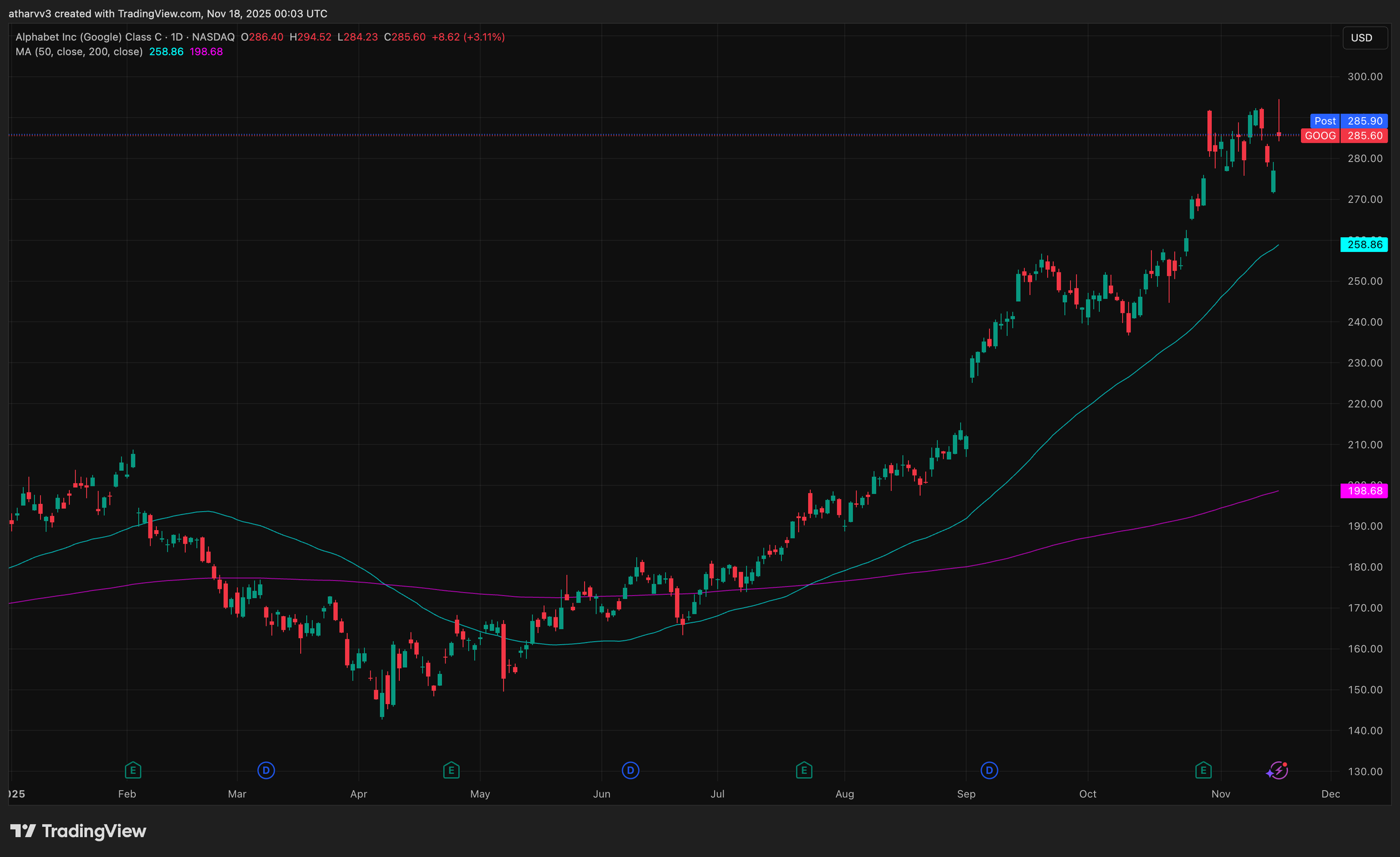
YTD Chart Analysis: Google
In this YTD chart of Google, you can see both a Death Cross around mid-April when the 50-day MA (Green) moved below the 200-day MA (Purple), and a Golden Cross in late July when the 50-day MA moved above the 200-day MA.
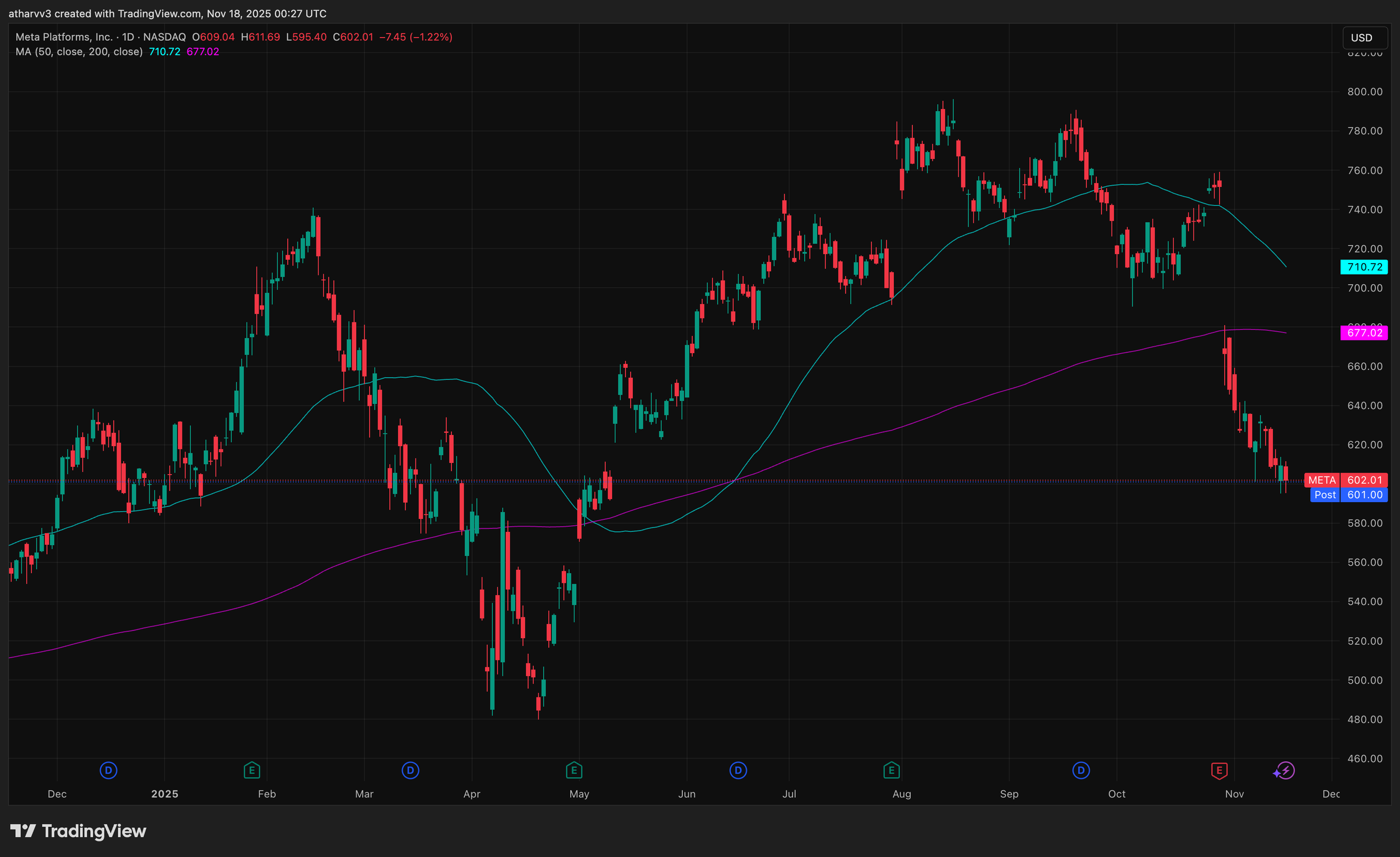
1-Year Chart Analysis: Meta
In this 1-year chart of Meta, you can see yet again, both a Death Cross around early May 2025 when the 50-day MA (Green), and a Golden Cross in mid-June when the 50-day MA moved above the 200-day MA. This quick reversal from a Death Cross to a Golden Cross can signify quickly shifting momentum from a bear market to a bull market, with the 200-day MA trending steadily upward the entire time.
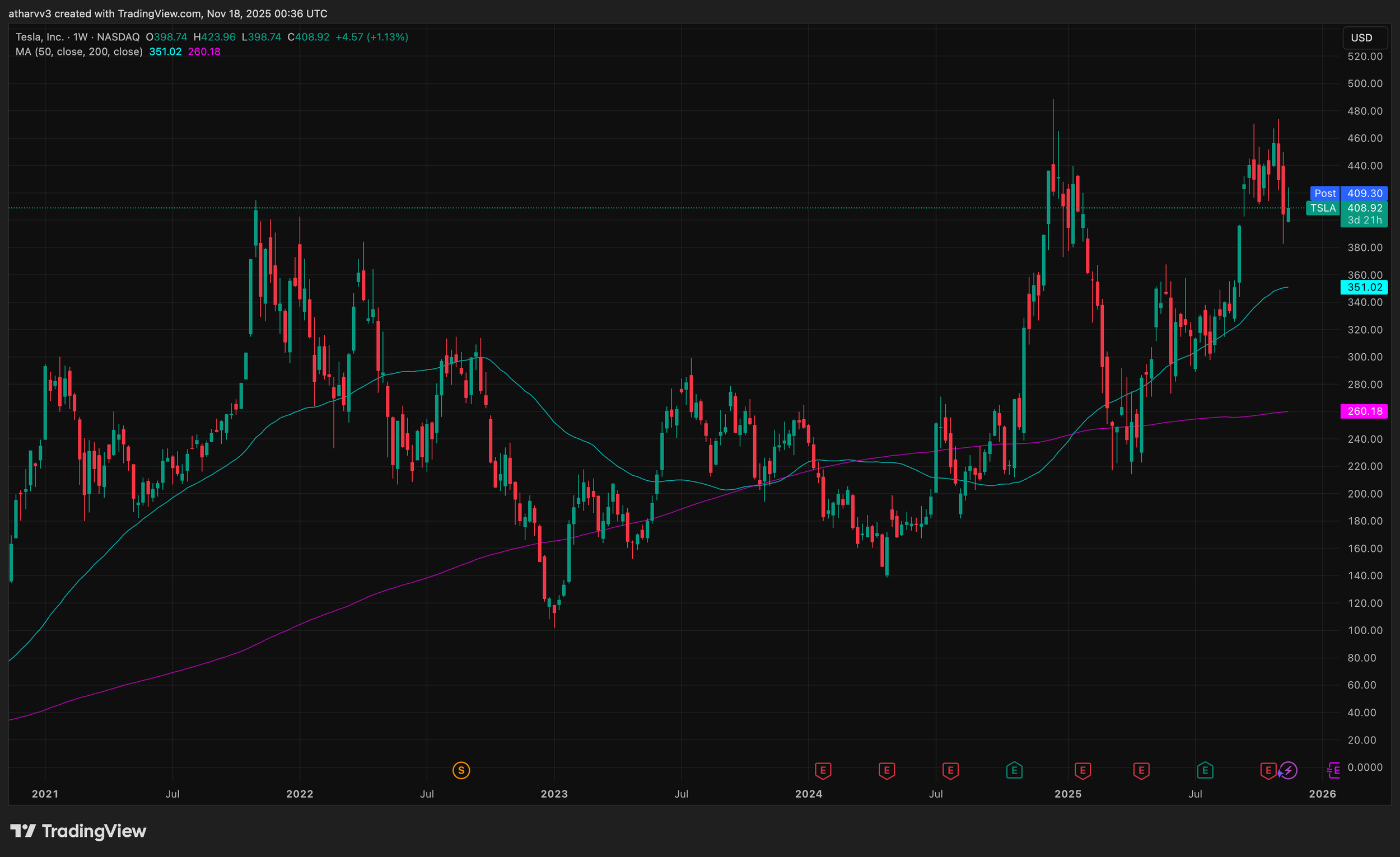
5-Year Chart Analysis: Tesla
In this 5-year chart of Tesla, we see numerous instances of both a Death Cross and a Golden Cross (50-day MA = Green, 200-day MA = Purple). Utilizing this long-term chart can allow us to visualize how “buying the dip” strategically at these crosses can increase returns, even for long-term investors.
Dollar-Cost Averaging (DCA) is an investment strategy where you invest a fixed amount of money and/or shares at regular intervals into the market/stock/asset. This is a strategy many long-term investors use to maximize their returns from assets while minimizing exposure in downturns. Now, let’s assume you’re a long-term investor, and you had two plausible scenarios. (1) You can buy $100,000 of each stock, applying random dollar-cost averaging by purchasing X $s at even intervals throughout the given timeframe (YTD, 1 Year, & 5 year) and hold it without selling. This is an example of a normal DCA. (2) You can buy $100,000 of each stock, but dollar-cost average strategically by purchasing only a proportional amount of shares at each Golden Cross (e.g. if there’s 3 Golden Crosses, you purchase $100,000/4 at the beginning and at each Golden Cross). This can be seen “strategic” DCA. Below, is an analysis on how both methods would impact overall and annualized returns.
Regular vs MA-Driven DCA Compared: Google (YTD), Meta (1 yr), Tesla (5yr)
Regular vs MA-Driven Dollar-Cost Averaging
Starting from a $100,000 portfolio, we compare a simple five-interval DCA strategy against a moving-average–driven DCA that deploys capital at the beginning of the period and at each Golden Cross (50-day MA crossing above the 200-day MA).
Table 1 – Regular DCA
Equal purchases at five evenly spaced dates in each timeframe.
| Asset | Timeframe | Total Return |
|---|---|---|
| GOOG | YTD | +51.18% |
| META | 1 Year | -4.07% |
| TSLA | 5 Years | +90.80% |
Table 2 – MA-Driven (Golden-Cross) DCA
Deploys capital at the start of the period and then at each Golden Cross.
| Asset | Timeframe | Total Return |
|---|---|---|
| GOOG | YTD | +51.78% |
| META | 1 Year | -3.01% |
| TSLA | 5 Years | +98.79% |
Full Excel Analysis Link: Regular vs MA-driven DCA Modeling
While the difference it total returns between regular DCA and MA-Driven DCA doesn’t look starkly different, we must remember that this is an analysis conducted on solely 3 stocks. Even among these three stocks, however, returns utilizing Golden Crosses yield anywhere from 1-10% higher returns, and when these returns are compounded over time, this can be a massive monetary difference. The best part about this strategy is how simple it is - an MA-driven DCA can be conducted in Yahoo Finance, Google stock tickers, as well as numerous other platforms that overlay the 50 and 200 day MAs on top of stock prices.
In a world full of complex technical indicators, noise, and varying opinions, moving averages can help keep investors like you grounded, psychologically in-check, and empirically sound.
Sources:
Chart Images: TradingView
Definitions: Investopedia
Concepts & Ideas:
Personal Opinion
Derivative & Trading Academy Coursework @UIUC
* NOTE: none of the info in this article or ANY article of MacroBytes is investment advice, it is solely an opinion for editorial purposes
